

If you're about to apply for a mortgage, or you've just been turned down for one, the first question is usually the same. What credit score do I need? It's a fair question. But there is no single credit score for a mortgage, and knowing why will help you more than any number.
This guide covers what lenders actually look at and how to get your credit file ready. It also covers what to check before you apply for a mortgage, a loan or car finance. Each section links to a fuller guide if you want to go deeper.
Is there a credit score you need for a mortgage?

No. There isn't a minimum score that every lender uses. As Experian puts it, "Mortgage lenders use their own scoring, so there's no 'magic number' you need to hit."
The score you see in an app comes from a credit reference agency. That's a company that collects information about how you've used credit and shares it with lenders. Each agency works out its own version of your score. Experian's now runs from 0 to 1250, and the other agencies use their own scales.
A lender doesn't simply read that number. It looks at the information behind it and applies its own rules. That's why two lenders can reach different answers about the same person in the same week.
Here's what this means for you. A good credit score for a mortgage application is a good sign, but it isn't a pass mark. The useful question isn't "what's my score?" It's "what will a lender see on my file?"
What lenders look at when you apply
Mortgage lenders test two things: your credit history, and whether you can afford the repayments.
On the credit side, Experian points to "information on your credit report, including your credit history and public record data, such as CCJs and IVAs." In practice, that means:
- Your payment history. Whether you've paid on time, and what happened when you didn't.
- How much of your available credit you're using. This is called credit utilisation.
- Recent applications for credit. These show on your file as hard searches.
- Public records. A County Court Judgment (CCJ) is a court order for an unpaid debt. An Individual Voluntary Arrangement (IVA) is a formal deal to repay debts over time.
- Financial associations. Anyone you share a joint account or loan with.
On the affordability side, lenders look at your income, your regular spending, your existing debts and your deposit. You can have a clean credit file and still be offered less than you hoped for. Affordability is a separate test.
If you're applying with someone else, their file matters too. MoneyHelper notes that a partner's poor credit history can affect a joint application. It suggests checking the "association" section of your credit report, so you both know what a lender will see.
For a closer look at how each part is weighed, see our guide to what mortgage lenders look at.
How to get your credit file mortgage-ready

Most of the work happens before you apply. MoneyHelper suggests you "avoid taking out new credit deals at least a year before you want a mortgage." That also gives you time to sort out anything on your file that needs attention.
A sensible order to work through:
- Check your credit report with each agency. A lender may check one or more of them. The agencies "might have different information from different credit providers," according to MoneyHelper.
- Look for anything that's wrong. Accounts you don't recognise, payments marked late that weren't, or addresses that were never yours.
- Raise a dispute on any errors. The agency holding the information has to investigate it.
- Register to vote at your current address. You can do it on GOV.UK. Being on the electoral register "helps companies confirm who you are and where you live," Experian explains.
- Remove old financial associations. If you no longer share any accounts with someone, such as an ex-partner, you can ask the agencies to remove the link.
- Keep balances steady and pay on time. One late payment years ago reads very differently from a run of missed payments last spring. What builds a file is patterns of consistency, not perfection.
- Hold off on new credit applications. Each one can leave a mark that lenders see.
Lenders usually update their records with the agencies every four to six weeks. So a balance you've just cleared may not show as cleared straight away. That's another reason to start early.
Our step-by-step guide to getting your credit file mortgage-ready walks through each one. If something looks wrong, see how to spot errors on your credit report. Then follow our guide on how to dispute a credit report in the UK.
Checking your chances before you apply
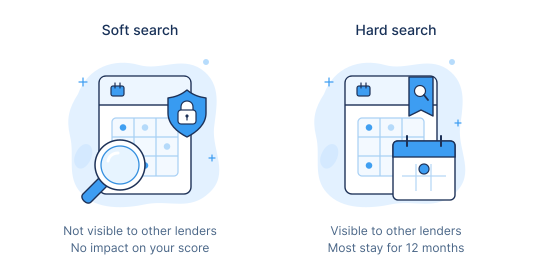
There are two kinds of credit search, and the difference matters before a big application.
A soft search is a light check. Experian says soft searches "aren't visible to companies," so they don't affect your score or your future applications. Checking your own credit report is a soft search, however often you do it. So is using a credit eligibility tool, which estimates your chances without a formal check.
A hard search happens when you formally apply. It's recorded on your file, and other lenders can see it. Experian says "most hard searches will stay on your credit report for 12 months." It adds that too many close together "can affect your credit score for six months."
A mortgage in principle is a lender's early view of how much it might lend you. You may also see it called an agreement in principle or a decision in principle. It isn't a formal offer, and MoneyHelper says it's "typically valid for 30 to 90 days."
The catch is that lenders handle it differently. MoneyHelper notes that some lenders "run a 'soft credit check'" for a mortgage in principle. Others "run a 'hard check', which is visible on your file." Ask which one a lender uses before you agree to it.
If you're comparing lenders, start with tools that use a soft search. Save the full application for the one you've chosen, so you don't collect hard searches along the way.
Our guide to credit eligibility checkers vs full applications explains how to use these tools well.
If you've been turned down
Being declined doesn't mean you've been blacklisted. There is no such thing. Credit reference agencies don't hold blacklists of people or addresses.
A lender doesn't have to tell you why it said no. But MoneyHelper says it "should tell you which credit reference agency they used." That tells you which file to look at first.
MoneyHelper's list of common reasons for a declined mortgage is your credit history, too much debt, your employment history, or not earning enough. It also points out that an application can be declined "even after you've been given an agreement in principle."
Here's what you can do next. Don't reapply straight away. MoneyHelper warns that "several refused applications in a short space of time might damage your credit score even more." Find out what the lender saw, deal with what you can, and then apply again.
Some of these steps are quick. Registering to vote and correcting mistakes on your file are both on MoneyHelper's list. So is checking what you can realistically borrow. It says that "checking what you can afford to borrow doesn't usually affect your credit rating."
If one lender has turned you down, MoneyHelper suggests a mortgage broker could help. Brokers can look at mortgages from a range of lenders.
Our guide to why you might be refused credit covers this step by step.
Building credit from scratch, or after a setback

Some people are turned down not because of anything bad on their file, but because there isn't much on it at all. If you're new to the UK, just starting out, or have closed most of your accounts, lenders have little to go on.
The basics are the same for everyone. Register to vote if you're eligible, keep a UK bank account in good order, and use any credit you do have steadily and on time. It takes time, and there's no shortcut.
If you're rebuilding after missed payments or a default, it helps to know how long that information stays on your file. Our guide to how long defaults, CCJs and missed payments stay on your credit report explains the timescales.
For the full picture, including what to do if you've just moved here, see our guide to building credit history in the UK.
Car finance, loans and credit cards
The same principles apply to smaller decisions. A car finance provider, a personal loan lender or a credit card company will look at your credit file. They'll also check whether you can afford the repayments. On car finance, Experian notes that "providers need to see if you can afford the monthly repayments."
When you formally apply, a hard search is recorded on your file. So the same advice holds. Check your report first, use eligibility tools where they're offered, and space out your applications.
If a mortgage is on the horizon, remember MoneyHelper's advice about new credit in the year before you apply. A new car finance deal counts as new credit too.
Which credit report should you check before you apply?
Ideally, all of them. A lender may check one or more credit reference agencies, and you won't always know which in advance. The three main agencies are Experian, Equifax and TransUnion, and each holds its own version of your file. MoneyHelper also lists a smaller fourth agency, Crediva.
By law, each agency has to give you your statutory credit report for free. It shows the information held about you. Experian describes its version as "a basic view of your credit history," and it doesn't include a score. When you apply, list every address you've lived at in the last six years.
You can request yours directly from Experian, Equifax and TransUnion. Our page on the statutory credit report explains more.
UK Credit Ratings is an FCA-authorised credit broker. Membership gives you your TransUnion credit report and score, with monitoring as it changes. You also get support from our UK team, including raising disputes on your behalf. It's an alternative to the statutory route with added features, not a replacement for it.
If a lender used Experian or Equifax, get the statutory report from that agency to see the same file.
For a fuller explanation of everything on your file, see understanding your UK credit report.
See your TransUnion report before you apply
Start your 14-day trial to view your TransUnion credit report and score, with support from our UK team if you need it. Your membership starts automatically when the trial ends, at £24.95 a month charged to the card you sign up with, unless you cancel. You can cancel without charge by contacting us before the end of the 14-day trial.
Start Your TrialFAQ
What credit score do I need for a mortgage?
There isn't one. UK mortgage lenders use their own scoring and criteria, so no single credit score for a mortgage decides the outcome. What matters is what's on your credit file and whether the lender thinks you can afford the repayments.
Is there a credit check for a mortgage?
Yes. When you apply for a mortgage, the lender carries out a hard search. It's recorded on your file and other lenders can see it. An earlier mortgage in principle may use a soft or a hard search, depending on the lender.
Can I get a mortgage with a low credit score?
It depends on the lender and on what sits behind the score. MoneyHelper notes that lenders have different criteria. It says some "might be willing to accept someone with missed payments from many years ago." A broker who can search the whole market can point you to lenders more likely to consider your situation.
Does a mortgage in principle affect my credit score?
It can. Some lenders use a soft search, which other lenders can't see, and some use a hard search, which they can. Ask the lender which it uses before you agree to one.
How long before a mortgage should I start preparing my credit file?
As early as you can. MoneyHelper suggests avoiding new credit deals at least a year before you want a mortgage. Starting early also leaves time to dispute any errors, because lenders usually update the agencies every four to six weeks.